In a traditional HR ecosystem, checking an employee’s onboarding status is a scavenger hunt. Managers often find themselves jumping between multiple dashboards, navigating complex case hierarchies, and switching tabs just to see if a laptop was ordered or if payroll is active.
What if an HR Manager could simply ask?
Using Pega GenAI Agent rules, I designed a multi-agent system that functions as a reasoning engine. It doesn’t just fetch data; it understands the dependencies of the onboarding lifecycle and takes action autonomously.
Use Case – Multi-Agent Onboarding

Functional Demo
Have a look at how it works before we delve into the technicalities
The Logic: The “Reasoning” Behind the Agent
The core of this implementation is a 5-step autonomous logic flow that the agent follows whenever an inquiry is made:
- Onboarding Case Audit: Check if an active case exists. If not, trigger the information collection flow.
- BGV Verification: Verify background check status. Crucially, the agent checks for an existing employee record before initiating a new BGV case to prevent duplicates.
- IT Provisioning: Validate IT setup. If missing, initiate the setup only after confirming the employee record exists.
- Payroll Integration: Ensure the employee is ready for their first paycheck by checking Payroll Setup.
- Status Synthesis: Only after all four pillars are validated does the agent confirm the onboarding is “Complete.”
Initial Architecture
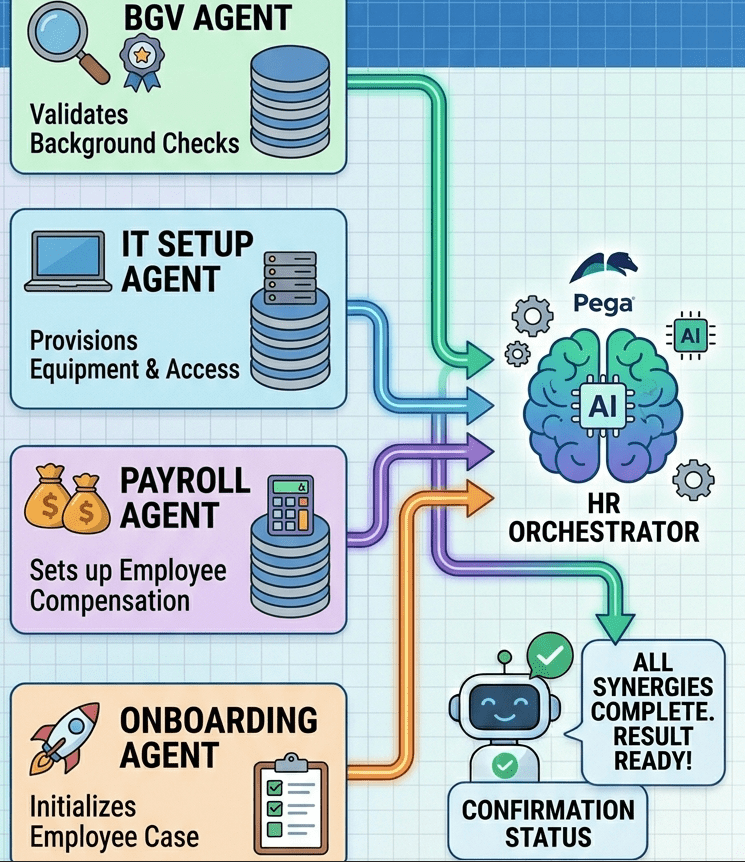
I envisaged the below architecture, to have dedicated Agents to handle each department’s tasks with their own knowledge and actions, but due to some issues, I have followed the actual architecture explained below

Implemented Architecture

In the Actual Architecture, we typically see siloed services. The Implemented Architecture in Pega, however, uses a Main HR Agent acting as the “Orchestrator.”
The Main Agent is equipped with specific Knowledge (Employee Records, Policy Docs) and Actions (Case Creation, Status Lookups).
The Prompt Design: The “Brain” of the Agent
I designed the HR Agent prompt to ensure it doesn’t just “chat,” but “reasons.” The prompt instructs the agent to:
- Decompose: Break the manager’s request into sub-tasks (BGV, IT, Payroll).
- Reason: Evaluate the state of each task based on the retrieved knowledge.
- Act: Use configured tools to invoke the necessary Pega flows.
System Prompt Snippet: > “You are an HR Specialist Agent. When asked about onboarding status, you must sequentially verify the Onboarding Case, BGV, IT Setup, and Payroll. Do not skip steps. If a record is missing, use the ‘Create Case’ action before proceeding…”
HR Agent Rule Configuration
Instructions Configuration

Knowledge Configuration

Tools/Action Configuration

Final Notes
Isn’t it a more efficient way to manage a workforce? By removing the need for manual navigation, we allow managers to focus on people, not processes. Pega GenAI transforms the system from a passive database into a proactive assistant
Thanking notes – Ganesh Pavan Munduri and Mounica Vatti for sharing their knowledge and tips. Gratitude towards Pegasystems for their continuous evolution and enabling the community